Friday, 7 October 2011
Cooking Hiatus
Well, I still have to cook...but I am on a month long restricted diet, a tempting to clear up a problem with allergic reactions. It is bland and monotonous, so I haven't felt much like cooking for the blog. I will try to get some posts up next week from photographs I already have.


Monday, 3 October 2011
Recipe Ethics
Not "ethnic recipes.|" It's happened to me before - I post a recipe - a tested, photographed and annotated recipe I developed from an older one, or even one that is creatively new, and someone posts it elsewhere with no credit, no link back to my work. I've called strangers to task for it, because this is plagiarism.
Recipes are really, really susceptible to it. There are only so many ways to make bread, or noodles, or roast beef. We are all working from the same basic techniques.
I don't have a lot of recipes on this blog yet because I do test every single one. I am as meticulous about it as a scientist in the lab. I make notes as I go, weigh and measure twice, take photographs, and sometimes make the recipe several times before I am satisfied. If I am using a vintage recipe, I must modify it for modern kitchens and ingredients, and every time, untangle and interpret the instructions, and improve on them for people who don't know what "cream butter" and "make sponge" mean.
Obviously, I put hours into every dish. I will accredit the originator of the recipe, if I know it, without plagiarizing, and if necessary, note the variants I have added.
If you take my recipe and directions and repost them, even if a little altered, then you have stolen my work. Maybe you wrote the recipe long hand and didn't note the source; maybe you copied and pasted and didn't think it mattered. But the minute you expose that recipe to a public audience- on a blog, on Facebook, demonstrating it on television or youtube even - you have stolen my hard work.
There is an implied international copyright on everything written, photographed or created. The creator has a right to control their work until they sign away the rights. This is the only blog I have with advertising. One of the ways Google designates the value of the advertising is by the number of visits to the site, and the number of links posted to the site. If you take my work and use it without links back to it, then I don't get those page visits, which keeps my statistics low and makes my site less valuable for advertising.
I hope this clarifies what can be borrowed or re-used. Ask questions if you want more information.
Recipes are really, really susceptible to it. There are only so many ways to make bread, or noodles, or roast beef. We are all working from the same basic techniques.
I don't have a lot of recipes on this blog yet because I do test every single one. I am as meticulous about it as a scientist in the lab. I make notes as I go, weigh and measure twice, take photographs, and sometimes make the recipe several times before I am satisfied. If I am using a vintage recipe, I must modify it for modern kitchens and ingredients, and every time, untangle and interpret the instructions, and improve on them for people who don't know what "cream butter" and "make sponge" mean.
Obviously, I put hours into every dish. I will accredit the originator of the recipe, if I know it, without plagiarizing, and if necessary, note the variants I have added.
If you take my recipe and directions and repost them, even if a little altered, then you have stolen my work. Maybe you wrote the recipe long hand and didn't note the source; maybe you copied and pasted and didn't think it mattered. But the minute you expose that recipe to a public audience- on a blog, on Facebook, demonstrating it on television or youtube even - you have stolen my hard work.
There is an implied international copyright on everything written, photographed or created. The creator has a right to control their work until they sign away the rights. This is the only blog I have with advertising. One of the ways Google designates the value of the advertising is by the number of visits to the site, and the number of links posted to the site. If you take my work and use it without links back to it, then I don't get those page visits, which keeps my statistics low and makes my site less valuable for advertising.
I hope this clarifies what can be borrowed or re-used. Ask questions if you want more information.
Tuesday, 20 September 2011
Egg Fu Yung with Zucchini
We like Chinese style food, but the average prepared Chinese restaurant or take-out meal is much too high in sodium and fat for us. Considering that the ingredients used are fairly low cost, the price seems a tad high, too. I adapted this recipe from one in More With Less, a famous Mennonite cookbook I first had back in the 1980s. My sister Jeanne was at university in Pennsylvania then, and got to know Mennonites. She sent me the cookbook for Christmas one year. I loaned that copy to someone and never got it back, and then bought another copy, which also disappeared the same way. I finally bought another copy this year through eBay. It has recipes from not only Mennonites living on farms, but missionaries and people who have traveled extensively. The recipes are simple, low cost, and nutritious, which is the mission of the editor and committee that compiled the cookbook.

Equipment: Box grater, knife, cutting board, mixing bowl, spoon, skillet and spatula, measuring cups and spoons.
Ingredients: Enough zucchini to make four cups grated, maybe one large or two mediumish zukes; 3-4 eggs; 1/3 cup flour; one clove garlic, pressed or minced; 1 finely diced or grated white onion, medium. For the sauce: 1 cup broth or stock, chicken or vegetable; 1 tablespoon soy sauce, preferably low sodium; 1 tablespoon cornstarch or arrowroot.

Directions: Wash but do not peel zucchini, cut into large pieces and grate on a box grater. Stir in the eggs, flour, garlic and onion. Fry in a little olive oil over medium high heat, turning when lightly browned. Keep warm in an oven set at 275-300F. Blend the sauce ingredients in a small saucepan, bring to a boil, reduce heat to a bubbling boil for a few minutes, until thickened.

Serve over rice or rice noodles, with the sauce poured over the little fu yung pancakes and anything else you are serving. I usually serve just steamed vegetables on the side. This is quick if you use the rice noodles, which cook in minutes.


Equipment: Box grater, knife, cutting board, mixing bowl, spoon, skillet and spatula, measuring cups and spoons.
Ingredients: Enough zucchini to make four cups grated, maybe one large or two mediumish zukes; 3-4 eggs; 1/3 cup flour; one clove garlic, pressed or minced; 1 finely diced or grated white onion, medium. For the sauce: 1 cup broth or stock, chicken or vegetable; 1 tablespoon soy sauce, preferably low sodium; 1 tablespoon cornstarch or arrowroot.

Directions: Wash but do not peel zucchini, cut into large pieces and grate on a box grater. Stir in the eggs, flour, garlic and onion. Fry in a little olive oil over medium high heat, turning when lightly browned. Keep warm in an oven set at 275-300F. Blend the sauce ingredients in a small saucepan, bring to a boil, reduce heat to a bubbling boil for a few minutes, until thickened.

Serve over rice or rice noodles, with the sauce poured over the little fu yung pancakes and anything else you are serving. I usually serve just steamed vegetables on the side. This is quick if you use the rice noodles, which cook in minutes.

Tuesday, 13 September 2011
Mennonite Bran Gems or Muffins
While I love to bake, so many homebaked goods are high in sugar and fat. That's what makes them taste so good, right? But there are good homemade treats that aren't all sweet and saturated, and can be served without a dollop of butter or jam. These little bran muffins, for instance, are delicious.
This is another adaptation of an old Waterloo County Mennonite recipe. I like this for a quick bread or sweet to go with afternoon tea, and my husband thinks they are as good as cookies. They aren't very sweet in terms of sugar, but the molasses and bran make them seem sweeter than they are.

Bran is part of the wheat kernel, and when flour is milled, it is removed. Usually it is included in the manufacture of boxed cereals or used for animal feeds. That's a pity, because it is nutritious and adds a good deal of necessary fibre to the diet. Why save it for grape nuts or bran buds, or feed it to the goats?
I buy it in the baking aisle of the store, or at the bulk foods store. It isn't expensive, and sometimes I add a half cup or so to baked products that are just white flour. It adds fibre without changing the taste or texture.
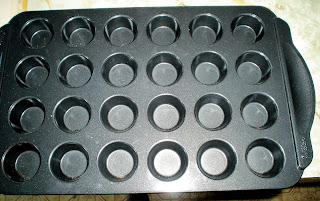
Equipment: Mixing bowl, mixing spoon or electric mixer, mini muffin or "gem" pan, measuring cup and spoons.
Ingredients: 1/3 cup white sugar; 1 tablespoon molasses; 2 tablespoons butter; 1 egg; 1 cup milk with 1 teaspoon vinegar, or 1 cup sour milk or buttermilk; 1 teaspoon baking soda stirred into 1/2 cup white flour; about 2 cups wheat bran.
Directions: Cream (mix thoroughly until soft) the sugar, molasses and butter. Beat in the egg, then the milk. Add the flour mixture, stir well. Add the bran until you have a soft, pourable dough that just starts to pull away from the sides of the bowl.
Butter the muffin tin cups and dollop a tablespoon or more or more of batter into each cup, depending on the size of the cups. My mini muffin pan takes about two tablespoons per cup, and that makes two dozen exactly.
Bake at 375F for 10-15 minutes or so, depending on the size of the muffins. Do not overbake. They should be nicely moist inside, without a crispy crust.

This is another adaptation of an old Waterloo County Mennonite recipe. I like this for a quick bread or sweet to go with afternoon tea, and my husband thinks they are as good as cookies. They aren't very sweet in terms of sugar, but the molasses and bran make them seem sweeter than they are.

Bran is part of the wheat kernel, and when flour is milled, it is removed. Usually it is included in the manufacture of boxed cereals or used for animal feeds. That's a pity, because it is nutritious and adds a good deal of necessary fibre to the diet. Why save it for grape nuts or bran buds, or feed it to the goats?
I buy it in the baking aisle of the store, or at the bulk foods store. It isn't expensive, and sometimes I add a half cup or so to baked products that are just white flour. It adds fibre without changing the taste or texture.
Equipment: Mixing bowl, mixing spoon or electric mixer, mini muffin or "gem" pan, measuring cup and spoons.

Ingredients: 1/3 cup white sugar; 1 tablespoon molasses; 2 tablespoons butter; 1 egg; 1 cup milk with 1 teaspoon vinegar, or 1 cup sour milk or buttermilk; 1 teaspoon baking soda stirred into 1/2 cup white flour; about 2 cups wheat bran.
Directions: Cream (mix thoroughly until soft) the sugar, molasses and butter. Beat in the egg, then the milk. Add the flour mixture, stir well. Add the bran until you have a soft, pourable dough that just starts to pull away from the sides of the bowl.
Butter the muffin tin cups and dollop a tablespoon or more or more of batter into each cup, depending on the size of the cups. My mini muffin pan takes about two tablespoons per cup, and that makes two dozen exactly.
Bake at 375F for 10-15 minutes or so, depending on the size of the muffins. Do not overbake. They should be nicely moist inside, without a crispy crust.

Friday, 9 September 2011
Another Apple Pie
This is a link to my friend Paula's blog. Paula and her husband farm in the Ottawa Valley of Ontario.
http://fletchingtonfarms.wordpress.com/2011/09/09/farm-girl-friday-9-september-2011/
If you are looking for an easier, less fiddly pie crust, this is a good one.
http://fletchingtonfarms.wordpress.com/2011/09/09/farm-girl-friday-9-september-2011/
If you are looking for an easier, less fiddly pie crust, this is a good one.
Thursday, 8 September 2011
More Than a White Sauce and a Garden Supper
So many recipes call for "a can of cream of mushroom soup" or a can of some cream soup. We dutifully add "cream soup" to the shopping list, doubting if it is really a healthy choice for an ingredient, not liking to pay at least a dollar, often more, for a can of soup, but wondering what could be substituted. Well, once you make white sauce, you will wonder no more, and the soup people will miss your money, which you will keep, since making a cup of white sauce is pretty cheap.
Equipment: Small saucepan, whisk, measuring cups and spoons.

Ingredients: to make a medium thick sauce, about the consistency of an undiluted can of cream soup - 2 tablespoons butter, or half butter and half olive oil, or all olive oil; 2 tablespoons flour (some people use instant flour here, but it isn't necessary); 1 cup of milk - skim, 1%, 2%, whole, or even part cream. Or substitute a half cup of chicken stock for half the milk. Have all the ingredients at hand on the stove top before you start.

Directions: Heat the butter/oil in the saucepan over medium heat until melted or just starting to bubble. Whisk in flour until smooth. Don't let it brown, so reduce the heat a bit. Now whisk in the milk, dribble by dribble - don't add it all at once - stirring slowly so that the fat/flour combination (this is called a roux) doesn't lump. Cook over medium-low heat, stirring or whisking constantly, until it is thickened nicely. Take off the heat.

That's it. If you feel you've been cheated all these years by the canned soup people - well, now you are wiser and won't be fooled again. It takes minutes to do this, and you get a nice consistency and a better taste.

To make it mushroomy, chop finely about four mushrooms, saute for a couple of minutes in olive oil or butter (not much, maybe a teaspoon), and add to the sauce. You can dilute the white sauce by whisking in slightly warmed milk for a cream soup. Add pureed and finely chopped steamed vegetables of choice, either before diluting, if using in a casserole, or while diluting for a cream soup.

Cheese sauce, which I served tonight, is made by stirring a half cup of grated cheese into the hot sauce. Add a 1/4 teaspoon of dry mustard to improve the flavour.
Garden vegetables are plentiful right now. I boiled quartered new red potatoes for about fifteen minutes, added peeled and sliced carrots for another five minutes, and then whole green beans, ends snipped off, for five more minutes. Drain all the boiled vegetables, and meanwhile saute a sliced baby onion or two, and a small zucchini. Chop a large double handful of fresh parsley. Toss all the vegetables together in a bowl, and add the parsley. Just before serving hot, pour on the cheese sauce.

That is what we had for supper, and it was very filling and satisfying.
Equipment: Small saucepan, whisk, measuring cups and spoons.

Ingredients: to make a medium thick sauce, about the consistency of an undiluted can of cream soup - 2 tablespoons butter, or half butter and half olive oil, or all olive oil; 2 tablespoons flour (some people use instant flour here, but it isn't necessary); 1 cup of milk - skim, 1%, 2%, whole, or even part cream. Or substitute a half cup of chicken stock for half the milk. Have all the ingredients at hand on the stove top before you start.

Directions: Heat the butter/oil in the saucepan over medium heat until melted or just starting to bubble. Whisk in flour until smooth. Don't let it brown, so reduce the heat a bit. Now whisk in the milk, dribble by dribble - don't add it all at once - stirring slowly so that the fat/flour combination (this is called a roux) doesn't lump. Cook over medium-low heat, stirring or whisking constantly, until it is thickened nicely. Take off the heat.

That's it. If you feel you've been cheated all these years by the canned soup people - well, now you are wiser and won't be fooled again. It takes minutes to do this, and you get a nice consistency and a better taste.

To make it mushroomy, chop finely about four mushrooms, saute for a couple of minutes in olive oil or butter (not much, maybe a teaspoon), and add to the sauce. You can dilute the white sauce by whisking in slightly warmed milk for a cream soup. Add pureed and finely chopped steamed vegetables of choice, either before diluting, if using in a casserole, or while diluting for a cream soup.

Cheese sauce, which I served tonight, is made by stirring a half cup of grated cheese into the hot sauce. Add a 1/4 teaspoon of dry mustard to improve the flavour.
Garden vegetables are plentiful right now. I boiled quartered new red potatoes for about fifteen minutes, added peeled and sliced carrots for another five minutes, and then whole green beans, ends snipped off, for five more minutes. Drain all the boiled vegetables, and meanwhile saute a sliced baby onion or two, and a small zucchini. Chop a large double handful of fresh parsley. Toss all the vegetables together in a bowl, and add the parsley. Just before serving hot, pour on the cheese sauce.

That is what we had for supper, and it was very filling and satisfying.
Sunday, 4 September 2011
Traditional Apple Pie

One friend tried to impress the man she was dating by making a pumpkin pie. the filling is just a custard with pureed pumpkin it it; that's pretty easy. She'd seen her mother make pie crust many times, and it didn't look like it took an advanced degree in engineering. So she pulled out the ever-faithful "Joy of Cooking" and got started.
First, the dough didn't want to hang together, so she added more water. This made it sticky, so as she rolled it out, she added more flour. And then some more flour. Then it was so stiff she had to bash it with the rolling pin to roll it into a circle big enough for the pie plate. The filling went in, she baked it as directed, and after a couple of grilled steaks and a nice garden salad, she served dessert.
The filling was great, she related. But the crust itself required a hacksaw. The pathetic empty crust had the same texture as an asphalt roofing shingle.
My father makes great pies, much better than my mother did. "Your mother was too impatient with it," he says. "You have to be gentle, gentle with it."
My Dad makes it sound like a Zen meditation, the Yankee equivalent of tea ceremony. Plan. Lay out the utensils and ingredients. Chill what needs to be chilled, including your attitude. Take your time. You can't rush a great pie crust.
Equipment: Mixing bowl, pastry blender, fork, pie plate.
Ingredients: To make a 9-inch double crust pie, 2 cups sifted flour; 1 teaspoon salt (or not if you prefer); 1/2 cup lard or vegetable shortening, cold; 1/4 cup or so of very cold water.
Do not substitute cooking oil for the solid shortening. I use lard because I am wary of how vegetable shortening is made to be solid at room temperature. Lard will make a flakier crust, too, but some people object to the subtle taste difference. Obviously, for a vegetarian pie you would use vegetable shortening. You can use fine whole wheat flour instead of white flour. I don't find a big difference.
Directions: Mix the salt into the flour in a bowl. Cut the lard/shortening into the flour with the pastry blender until it is pretty thoroughly mixed in. (Some people say until the particles are the size of small peas, or rough ground meal. It just needs to be well blended, but not so worked over that it gets warm and starts to melt.) Now add the cold water all at once, stir quickly with a fork to work in most of the flour/fat particles. Don't worry if there is some at the bottom of the bowl. Try not to add more than a tablespoon more, working quickly, if it seems way too dry. This will be a fairly dry dough.

Now turn it out onto a floured pastry board or counter top. Very lightly knead it gently to hold it together. It should look like layers of shale or something flaky, not like bread dough. With a floured rolling pin, and a little flour sprinkled over the top, work half the dough out into a round, rolling from the middle with a light touch. When it is big enough to fit in the pie plate and up the sides, lift it with the rolling pin and slide it in. Roll out the other half the same way, and set aside. I sometimes refrigerate the dough before rolling it out, and if the kitchen is warm, put the rolled dough in the refrigerator while you get the filling ready.
Apple filling:
Peel and core 7-9 medium to large apples. I used yellow transparent for this pie, as the flavour is old-fashioned appley, although the slices dissolve into a wondrous apple butter. If you want visible slices, use a firmer cooking apple. Slice into eighths or so, but not too thin. Toss in a bowl with about 2/3 cup of white sugar or, half white, half brown; 2 tablespoons flour; 1/2 teaspoon ground cinnamon; 1/4 teaspoon each nutmeg and allspice. Spoon into the prepared pie crust (don't prick the lower crust, though, or you will have a gooey mess), add some dabs of butter, about 4 teaspoon size pieces, then top with the crust. Trim the crusts around the outer edge of the pie plate, and fold the two crusts together inside the plate. My mother always crimped hers along the lip of the plate, and the filling always bubbled out and burned in the oven. Then cut slits in the top crust to vent the steam.

Bake for ten minutes at 400F, then turn down the heat to about 350F for 30-40 minutes, until the crust starts to brown. If you like a nicely browned crust, brush it after the first ten minutes with a bit of milk. My crusts don't brown as much in the wood stove as the heat is even all around and not concentrated at the bottom.

Subscribe to:
Posts (Atom)